
Are you holding more than you can bear?
Other ways to think about handling responsibility

On a day where the world felt heavy, I looked up from my seat on the tube. Above the heads of my fellow commuters, sat this poem by Janet Frame:
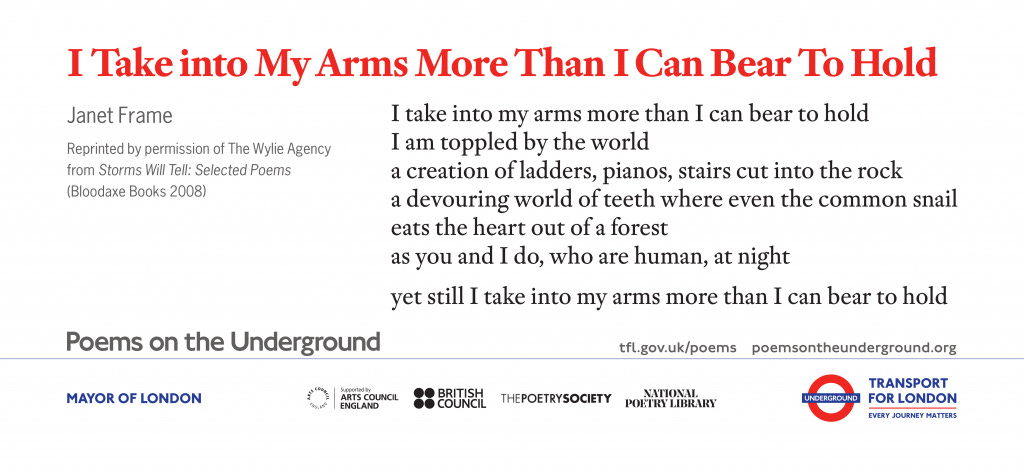
“I take into my arms more than I can bear to hold
I am toppled by the world
A creation of ladder, pianos, stairs cut into the rock
A devouring world of teeth where even the common snail
Eats the heart out of a forest
As you and I do, who are humans, at night
Yet still I take into my arms more than I can bear to hold”
Something in this poem caught in my throat. It stood out in sharp contrast to the lying adverts (that AI could solve your very human problem, or that botox could solve your very human face) it was sandwiched in between.
Sometimes, life gives us heavy things to hold: Heartbreak and hurt that feel like they may topple us. Sickness that erodes our energy or our capabilities. Loss that feels impossible to shoulder. Violence that weakens us. It’s unlikely we’d choose to pick up and carry these challenges, and it’s often hard to put them down. All this can feel unbearable and yet we bear it somehow. One way or another, you and I are trying to find ways to hold what life presents.
To be clear, when I talk about holding I’m not talking about saving, fixing, martyring, swooping in from above like we know best. Holding is something else that runs alongside and intertwines a life. Holding is not always warm, gentle and easy. Holding is often confronting, messy and difficult. Holding can come in the form of acting in solidarity, companionship and sometimes love. It can be about building comfort, bearing witness, sharing a burden, building warmth and shelter and providing other necessary resources. These acts of care can be a safe base from which people can collaborate and create. As literal or figurative steadying, holding can be a foundational force from which to co-produce a different version of a life.
Holding is effortful. Sometimes we do not feel strong enough to bear the act of holding, but we end up doing so anyway.
We live in a world that can devour us with its difficulty, and the different ways we can respond show up at small and large scales. The personal is political after all.
Some respond to the weight of the call with nihilistic, militaristic, defensive actions. Their refusal to hold others is written into geopolitical decisions. Their refusal to hold translates into an arm race, rather than arms that hold. Medical profiteering creates needless wait times and costs for health care; white supremacist regimes mandate violent migration policy which creates distance between people and their communities; love between particular people is made punishable. All of this making it harder for people to hold one another.
They relentlessly outsource their share of carrying the weight of the world. They try really hard to convince us that care a distraction. In their eyes, what matters is profiting off exploitation of people and planet.
Yet they know that people need care because they need it themselves. I recently learnt in conversation with Professor Sarah Knott, that the 1% (our world’s most wealthy) consume the most care work globally. Whilst they themselves are reliant on servants, exploitative labour and slavery they create policies that make it hard for regular people to access the basics.
Others respond to the call with arms that hold. Not always literally, but more broadly with politics structured around care. In this vision, care isn’t a distraction or an interruption. Policies enable care work to be valued and more evenly distributed. Work is done to build the foundations for health, wellbeing and connections between people. Infrastructure is built to enable social connection. Those working to care are recognised and valued. Health care, child care, elder care, all sorts of care are funded, supported and celebrated.
It isn’t always either one or the other. We live in a messy political landscape. Those with economic power will undertake acts of care one day and withdraw them the next, or give support to one group but not another, provide welfare but on strict and punitive conditions. Regular people (particularly women and people of the global majority) are both forced to provide the majority of care work, but are also economically punished for doing so.
But let me return to where we started, those days where it all feels too heavy to hold. So, what if we’ve pitched our tent in the second camp - where we actively support calls for a caring culture - but personally we struggle bear the weight of it?
How do we handle the weight of what we need to hold without being ‘toppled by the world’?
On days when I tell people I’m finding it hard to hold what I am holding, I usually am told that I should:
put it down: relinquish responsibility
significantly limit the scale of my care
let go of what does not serve me
stop performing emotional labour
draw boundaries
let people deal with their own problems
cut people out who are experiencing difficulties
stop being a people pleaser
outsource caring responsibilities to others
signpost people to experts, medical institutions or the state
focus on myself
practice self care
talk to a therapist / doctor
rest
regulate my nervous system
care less
feel less
I don’t blame the people who have suggested these to me, they aren’t entirely wrong, nor entirely right. There’s kernels of wisdom in a lot of it. I have made some of these suggestions to people in my life too. (Ironically, sometimes all they needed was to be held, a hug or empathetic ear. Sometimes they did need a practical plan though, and this is what I’m talking about here.)
It makes sense that we suggest these approaches to one another. They are are some of the established and emerging routes for those of us trying to navigate the complexity and avoid the teeth of this ‘devouring world’, without resorting to the violent techniques of that first camp I set out earlier. We are trying to remain intact, uneaten.
Some of these approaches are straight-up spiritual bypassing or capitalist individualism repackaged as empowering easy fixes. They can be used to ease guilt or reassure care givers, but fail to actually change things for the better for the cared for party. Others have limited and context-specific usefulness, depending on the goal.
If the goal is to protect and safeguard myself (which is, in part, a foundation for the sustainability of care) a lot of these approaches are helpful. I have tried some version of them all, to varying success. Some have helped me persevere; some have helped me hold myself and others better; some have protected me from needless harm; some have improved my health; others have pathologised my human desires to care, have purpose, and connect with others. Despite all these approaches, my heart - because it is a human heart - is still heavy sometimes. I don’t think total lightness is the goal.
If I shift the goal towards how I can develop my capacities to hold - because I want and need to hone in my holding ‘skills’ - often the ‘solutions’ I hear lessen my chances to practice holding. If I understand my liberation as always tangled up in others’, sometimes these approaches encourage me to disentangle me from others.
If I shift the goal further, towards how we can collectively develop our ability to respond to need, I find this suggested atomised approach often feels woefully misguided and feeble within the broader political economy of unevenly distributed caring responsibilities.
We need something different. A nuanced approach that takes into account the goals of both individual and collective liberation. That sees freedom as a shared endeavour.
In the next few posts on Care Curriculum, I will be exploring the strengths and limits of these ‘solutions’ proposed to the ‘problem’ of the weight of care. I’ll bring you insights from over a decade of my professional work on care, findings from my research and the work of others. I’ll try to offer joyful and inspiring approaches. I’ll shared alternative stories, frameworks and practices that are already out there and ones that are being schemed up.
Please subscribe or follow along to hear more:
Exactly what I needed to read today, thank you ❤️ and really looking forward to the series!